RO Plant Manufacturer in India
Aquantam designs and manufactures RO water treatment plants for industrial, commercial and institutional applications. Each industrial RO plant is engineered around the feed-water quality, the treated-water quality required and the capacity you need.
What is an RO plant?
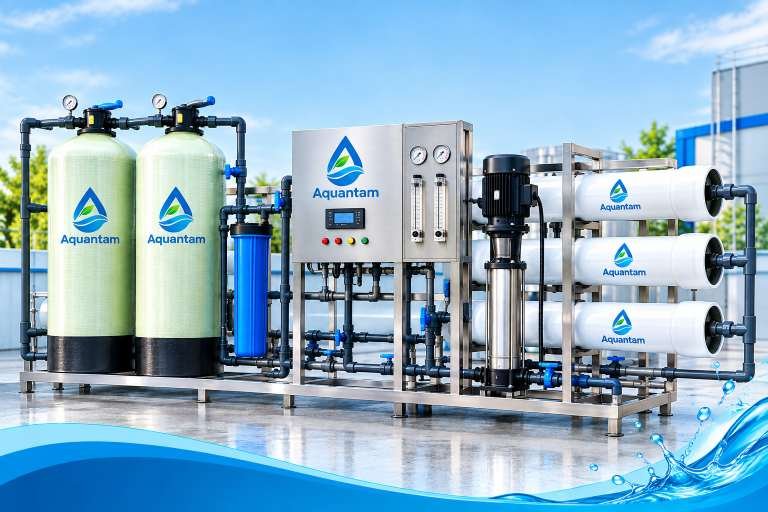
A Reverse Osmosis (RO) plant is a water treatment system that pushes water through semi-permeable membranes under pressure to remove dissolved salts and other contaminants. The purified stream, called permeate, becomes the treated water. The concentrated stream, called reject or concentrate, carries the removed contaminants and has to be managed or reused.
RO is rarely a stand-alone step. Membranes are sensitive to suspended solids, organic matter, chlorine, hardness and scale-forming compounds, so an industrial RO plant is normally paired with pretreatment sized for the feed water. That is why the same RO capacity can call for very different plant configurations at different sites.
How an RO water treatment plant works
A typical RO plant follows the sequence below. The exact stages depend on the feed water.
Feed-water storage
Raw or pre-treated water is collected in a feed tank, which stabilises flow and gives the plant a consistent supply.
Pretreatment
Depending on the feed water, this may include multimedia filtration, activated carbon filtration, softening, chemical dosing or ultrafiltration to protect the membranes from fouling and scaling.
Cartridge filtration
A final fine filter catches remaining particles before the high-pressure pump.
High-pressure pumping
A pump raises the water to the pressure needed to drive it through the membranes.
Membrane separation
Water passes through the RO membranes as permeate, while dissolved salts and contaminants stay in the concentrate.
Post-treatment and storage
Permeate may be adjusted for pH, disinfected or polished as required, then stored for use. The concentrate goes to discharge, further treatment or reuse.
Where RO plants are used
Process water
Manufacturing processes that need water with lower dissolved solids than the raw supply.
Boiler and utility feed
RO is often used ahead of demineralization or as feed preparation for utility systems.
Pharmaceutical and food processing
Water preparation stages, subject to the quality standards that apply to the product.
Drinking and commercial water
Purified water for offices, hospitality, healthcare and institutional facilities.
Water recycling
RO polishing of treated wastewater so it can be reused.
Concentrate reduction
Membrane concentration within ZLD and high-recovery systems.
How Aquantam approaches RO plants
Aquantam engineers each RO plant from the water analysis outward: pretreatment first, then membrane selection and array, then post-treatment and controls. Plants are configured around capacity and available space, and, where included in scope, installed and commissioned with technical support.
What determines RO plant design
- Feed-water TDS, hardness, silica and organics
- Required permeate quality
- Target recovery rate
- Capacity and operating hours
- Feed-water temperature
- Fouling and scaling potential
- Energy consumption
- Cleaning and maintenance access
Frequently Asked Questions
What does an RO plant remove?
An RO plant removes most dissolved salts, along with many organic compounds, bacteria and other contaminants, depending on the membrane and the feed water. Actual rejection depends on membrane type, pressure and water chemistry.
Why is pretreatment needed before RO?
Suspended solids, organics, chlorine, hardness and other scale-forming compounds can foul, scale or damage membranes. Pretreatment protects them, which supports stable output and longer membrane life.
What is RO recovery?
Recovery is the share of feed water that becomes permeate. Higher recovery reduces reject volume but raises scaling risk and energy use, so the target is set from the feed-water chemistry.
What happens to RO reject water?
Reject water carries the concentrated salts. Depending on its quality and applicable regulations, it may be discharged, treated further, reused for lower-grade purposes or sent to a ZLD system.
Can an RO plant be customized?
Yes. Capacity, pretreatment, membrane configuration, materials, automation and layout can all be tailored to the feed water, required output quality and site.
Request a Quote for Your RO Plant
Share your city, capacity and water details, along with any analysis report you have. Aquantam will review your requirement and come back with a suggested treatment approach and next steps.
Tell us about your requirement
Fields marked * are required.