
STP Plant Manufacturer in India
Aquantam supplies sewage treatment plants for residential, commercial and institutional sites. Each STP is sized for the site's occupancy and flow, with biological treatment, filtration and disinfection as required.
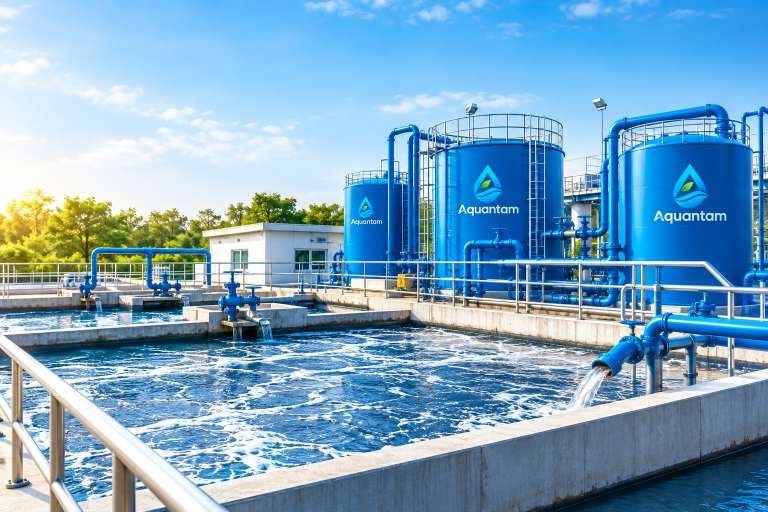
What is an STP plant?
A Sewage Treatment Plant (STP) treats domestic and commercial sewage, typically using biological treatment followed by filtration and disinfection where needed, so the treated water can be discharged or reused as permitted.
Sewage is mostly organic and fairly consistent in composition, but the flow rises and falls through the day. A well-designed STP handles those peaks, produces water of a stable quality and is simple enough for a site team to operate.
How a sewage treatment plant works
The process type is chosen to suit the site. The common sequence is below.
Screening and grit removal
Screens and grit chambers remove rags, plastics and heavy solids that would damage equipment.
Equalization
A balancing tank evens out the hourly variation in sewage flow.
Biological treatment
Microorganisms break down dissolved and suspended organic matter in an aerated process, with the process type chosen for the site.
Secondary clarification
Biological solids settle out, leaving clarified water and sludge.
Tertiary treatment
Filtration and, where needed, activated carbon polish the water for reuse.
Disinfection
Chlorination or another disinfection step reduces pathogens in the treated water.
Sludge handling and reuse
Sludge is dewatered and removed. Treated water is reused where permitted or discharged in line with regulations.
Where STPs are used
Residential apartments and townships
On-site treatment for housing developments.
Commercial buildings
Offices, malls and business parks.
Hospitals and healthcare
Round-the-clock sewage treatment for facility wastewater.
Hotels and hospitality
Treatment and reuse of guest and housekeeping wastewater.
Institutions and campuses
Schools, colleges and large campuses.
Infrastructure projects
Sewage treatment for large or remote developments.
How Aquantam approaches STPs
Aquantam sizes each STP from occupancy and flow data, then selects the treatment stages and reuse arrangement to match. Where included in scope, support extends through installation, commissioning and operation and maintenance.
What determines STP design
- Number of users and daily water use
- Peak flow and organic load
- Treated-water standard
- Planned reuse (flushing, landscaping, cooling make-up)
- Available land or building space
- Power availability
- Operation and maintenance capability
- Local regulatory requirements
Frequently Asked Questions
What is an STP plant?
An STP plant is a Sewage Treatment Plant that treats domestic and commercial sewage so the water can be discharged safely or reused, as permitted.
How is STP capacity decided?
Capacity is estimated from the number of users and their water use, with allowance for peak flow. A designer works this out from your building or campus details.
Where can treated sewage water be reused?
Depending on quality and applicable norms, treated water can be used for flushing, landscaping, cooling make-up, washing or other non-potable purposes.
Is an STP mandatory?
Requirements vary by location, building type and size, and are set by local and state authorities. Check with the applicable regulator or your project consultant.
What is the difference between an STP and an ETP?
An STP treats domestic and commercial sewage. An ETP treats industrial process wastewater, which varies more and often needs staged chemical and biological treatment.
Request a Quote for Your STP Plant
Share your city, capacity and water details, along with any analysis report you have. Aquantam will review your requirement and come back with a suggested treatment approach and next steps.
Tell us about your requirement
Fields marked * are required.